


Key Takeaways
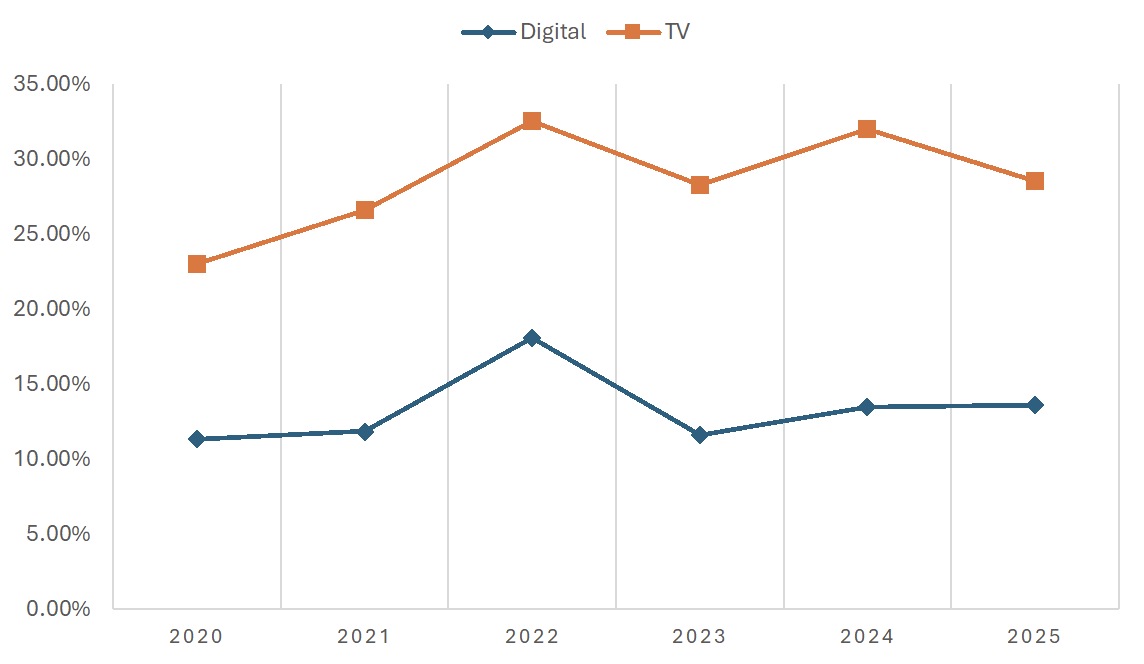
- By month of delivery, both Digital and Television reach near full commitment (~94–98%), but Digital gets there much earlier
- Digital budgets are now roughly double Television in commitments made two months prior
- Within TV, Broadcast still leads in early commitments (~18% booked three months ahead), but its stability has weakened as agencies adjust allocations closer to delivery
- Cable TV has shifted earlier — commitments made two months out have doubled since 2019 — signaling a more disciplined planning environment
- These diverging rhythms define a “two-speed marketplace”: Digital as the forward anchor, Television as the tactical lever
Over the past several years, agency planning rhythms have quietly split into two distinct tempos. According to Guideline’s data, agency commitments for Digital now average ~29% locked three months out, compared to only 14% for Television.
Digital channels — once prized for flexibility — have become the anchor for forward planning, where budgets are locked earlier and held steadier.
Television, meanwhile, remains the tactical lever, shifting closer to delivery as buyers chase agility and last-minute opportunities.
By one month before delivery, both are nearly fully committed, but the path to that point is radically different — a reflection of how agencies are managing predictability and risk across media types.
A Structural Shift in How Agencies Plan
This divergence isn’t just operational — it’s strategic.
Digital’s early commitments show that agencies now treat it as the foundation for pacing and forecasting, benefiting from stable performance and predictable delivery.
Television, by contrast, has evolved into a moment-based medium — optimized for campaign bursts, cultural moments, and last-minute buys.
Within Television, Broadcast TV still carries early intent through the upfronts, but mid-horizon revisions have increased as marketers rebalance spend.
Cable TV, however, has moved sharply earlier — commitments two months out rising from 31% in 2019 to 63% in 2025 — signaling a shift toward more disciplined planning even in historically flexible environments.
Together, these behaviors form a two-speed marketplace — one side anchored in planning discipline, the other in tactical adaptability.
For agencies and advertisers alike, success depends on how well they synchronize those speeds.
Beyond Channels: A Bigger Story Emerging
This early vs. late planning divide is only one part of a much larger picture emerging in Guideline’s October 2025 Metrics in Motion.
Across the report, similar patterns appear in category-level behaviors, commitment pacing, and budget velocity — each offering a window into how advertisers are regaining confidence after years of volatility.
What starts with Digital vs. TV becomes a broader story about discipline returning to the ad market — and where flexibility still pays off.
For a deeper look at how advertiser planning behaviors are evolving — across timing, category, and channel — reach out to our team to download Metrics in Motion 2025.
.png)