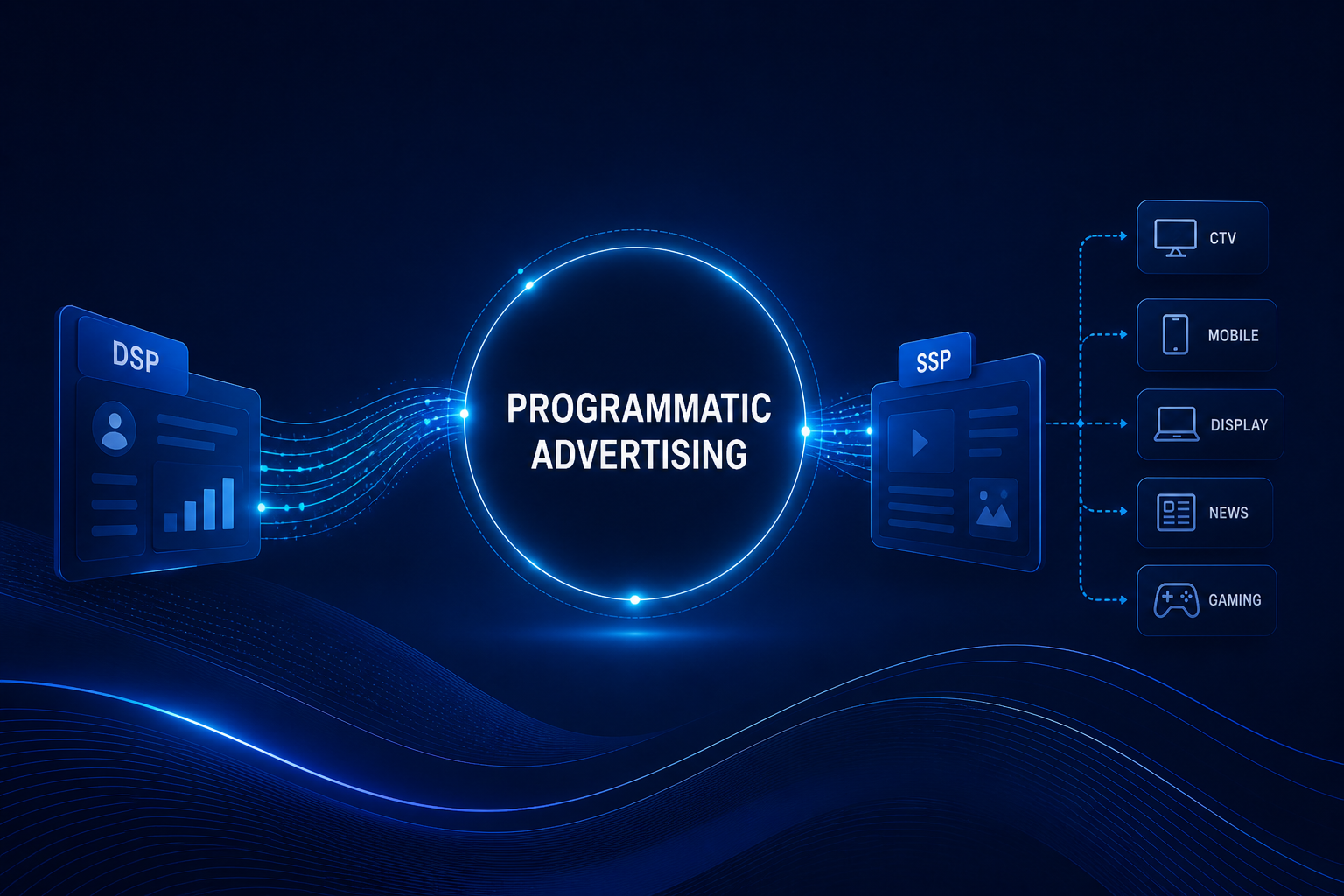


Programmatic advertising has always been framed as a demand-side story—focused on how advertisers buy.
But the real shift is happening on the other side.
In this week’s Media Monitor, Kelly Sweeney and Sean Wright break down how supply-side platforms (SSPs), connected TV, and evolving inventory dynamics are reshaping how programmatic actually functions—and where it’s headed next.
Understanding the Supply Side of Programmatic
If demand-side platforms (DSPs) represent buyers, SSPs represent the other half of the equation.
They aggregate available ad inventory from publishers and make it accessible to buyers in real time—essentially acting as the infrastructure that enables programmatic transactions to happen at scale.
This supply layer is critical. It determines:
- What inventory is available
- Where ads ultimately run
- How pricing and competition play out
And increasingly, it’s where some of the most important changes are happening.
The Shift to Programmatic in Connected TV
One of the clearest trends emerging from the data is the rapid shift toward programmatic buying in connected TV (CTV).
Just a few years ago, most streaming ad inventory was still transacted directly. In 2022, only about 30% of CTV ad spend was programmatic.
Today, that number is approaching 50%—and continuing to grow.
This is a fundamental shift in how premium video inventory is bought and sold.
As programmatic expands:
- Inventory becomes more standardized
- Pricing becomes more competitive
- Buyers prioritize audiences over specific publishers
The result is a more flexible—but more commoditized—marketplace.
Streaming, Scale, and the Return of “Cable-Like” Dynamics
At the same time, the rise of ad-supported streaming is accelerating this shift.
Consumers are increasingly choosing lower-cost, ad-supported tiers, while free ad-supported TV (FAST) platforms continue to grow.
This creates:
- More inventory available for bidding
- More opportunities for programmatic transactions
- Greater reliance on SSPs to manage and distribute supply
Ironically, the streaming ecosystem is beginning to resemble traditional TV—just with more complexity and more intermediaries.
Q1 Trends: Growth, But Slowing Momentum
From a macro perspective, programmatic continues to grow—but at a more measured pace.
In Q1:
- Programmatic spend grew approximately 7% year over year
- Growth was partially driven by events like the Olympics
- Expansion slowed compared to prior years of rapid scaling
This moderation reflects a maturing market.
In earlier phases, growth was fueled by:
- Rapid user expansion across platforms
- Significant increases in available inventory
Today, those factors are stabilizing—leading to more sustainable, but slower growth.
Who’s Gaining Share—and Why
At the platform level, a few key players continue to define the market:
- Google (DV360) has expanded to roughly 41% market share globally, continuing steady gains year over year
- The Trade Desk has stabilized after rapid growth, maintaining a consistent position
- Amazon DSP has grown from ~14% share in 2022 to nearly 20% today, driven by aggressive expansion
These shifts highlight a broader trend: consolidation at the top, with scale and data advantages becoming increasingly important.
Category Shifts: New Entrants Into Programmatic
Beyond platforms, advertiser behavior is also evolving.
One notable trend is the expansion of pharmaceutical advertising into programmatic—particularly in the U.S.
Historically limited by regulatory complexity, pharma is now:
- Entering programmatic channels more aggressively
- Increasing competition for inventory
- Contributing to overall demand growth
This reflects a broader pattern: as programmatic infrastructure matures, more categories become viable participants.
What to Watch: Growth Expectations vs. Market Reality
Looking ahead, expectations for programmatic growth vary widely.
Some forecasts suggest double-digit expansion—but the data tells a more cautious story.
Key constraints include:
- Slowing growth in available ad inventory
- Stabilizing user bases across major platforms
- Broader macroeconomic pressures
Based on current trends, growth closer to mid-single digits may be more realistic in the near term.
That said, major events like the World Cup could still create temporary spikes in demand.
The Takeaway
Programmatic is no longer in its rapid expansion phase—it’s entering maturity.
The focus is shifting from:
- Adding more inventory
- Scaling new platforms
To:
- Optimizing how supply and demand connect
- Improving efficiency across the ecosystem
- Managing pricing and competition in a more balanced market
The supply side is no longer just infrastructure—it’s a strategic driver of how programmatic evolves.
The Media Monitor Mission
Media Monitor exists to bring clarity to the trends reshaping media, advertising, and consumer behavior.
New episodes drop every Wednesday on YouTube, Spotify, and Apple Podcasts, covering the market shifts that matter most to media, advertising, and strategy teams.
If you want to go deeper into how these trends are affecting your media investments, connect with our team to learn more.
.png)